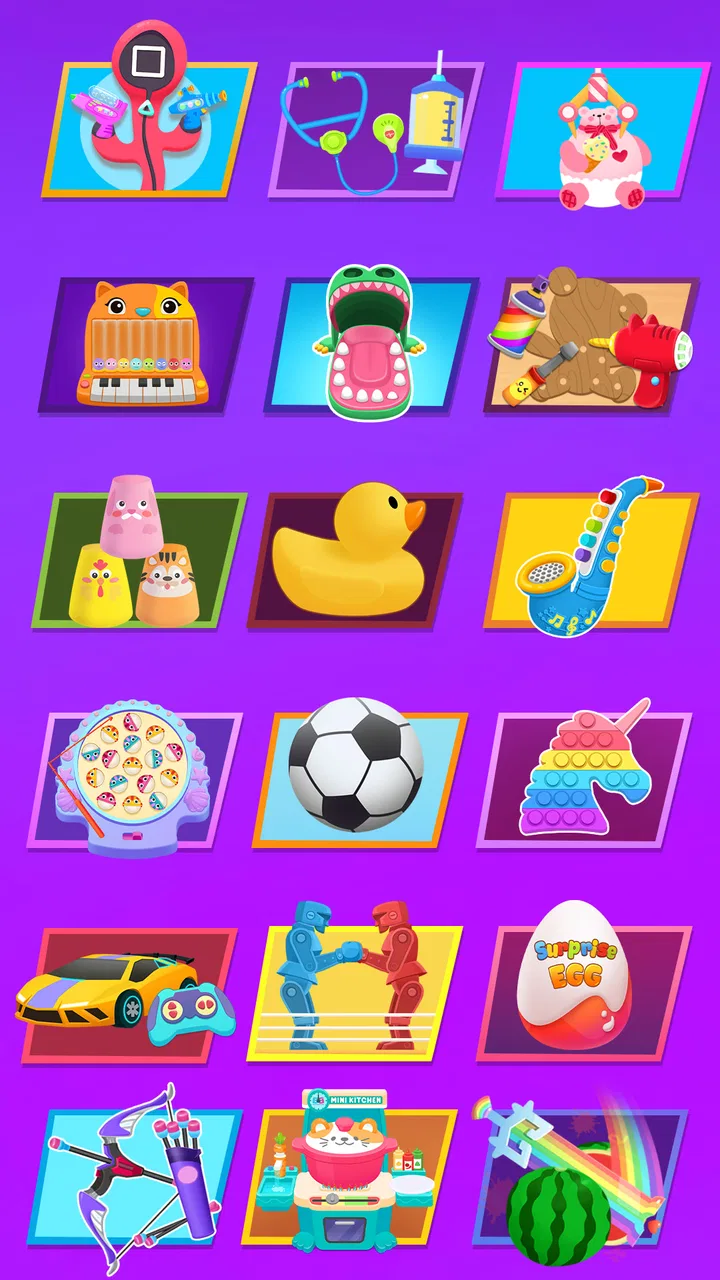
Toy And Games for kids & Baby
- 3.5
- Rating
- 10.00M
- Installs
- Free
- Price

 Analysis by App-foxy
When I first opened Toy And Games, I expected a simple collection of activities for young children rather than a game with a long learning curve. That expectation is important because this educational title works best as an easy-to-start distraction, a short play session, or a parent-guided activity. It is free to download, aimed at Everyone, and comes from BonBonGame.com. The central appeal is variety: children can move between many toy-themed activities instead of being locked into one narrow lesson.
That variety is also where the experience can become confusing. A child may understand one activity immediately but need help finding another, returning to a previous screen, or working out why a tap did not produce the expected response. I found that the app is most enjoyable when an adult spends a few minutes checking the basics before handing over the device. The best results come from treating it as a flexible play box, not as a complete preschool curriculum.
Getting past the first points of friction
I’d start by treating a confusing moment as a chance to simplify the session, not as proof that the game has failed: pause, choose one activity, and model one clear action before handing control back. That gives you a better read on whether the child needs a little guidance or the interaction itself is frustrating. From there, it’s worth looking at how to make the collection fit into an ordinary day.
You May Also Like

 Blood Strike: 2.5 Anniversary
Blood Strike’s Loadouts Turn Every Drop Into a Tactical Gamble
A close look at Blood Strike’s custom loadouts: how fast access to signature weapons reshapes its battle royale rhythm, rewards preparation, and narrows the gap between fights.

 Pandora - Music & Podcasts
Pandora’s Music Is Easy to Start, but Harder to Recover
Pandora’s strength is its low-effort path from a seed to a station. Its weak spot is how much confidence it asks you to place in connection, setup, and quiet recovery.

 8 Ball Pool
 Is Built on Rivalries, Rematches, and Routine
A close look at the rivalries, rematches, shared routines, and unanswered safety questions that turn a quick pool match into a persistent mobile community.

 Samsung Music
’s Quiet Strength Is Playing What You Already Own
Its reach comes less from spectacle than from dependable access to a personal library. That simplicity is both the app’s strongest retention engine and its ceiling.

 AccuWeather: Weather Radar
AccuWeather Review: A Quick, Clear Forecast for Everyday Decisions
For everyday plans, the best forecast is the one you can understand quickly. AccuWeather makes rain timing, radar, and local conditions easy to act on, with a few trade-offs.

 Hill Climb Racing
Why Hill Climb Racing Still Turns Crashes Into One More Run
A tiny car, a bumpy hill and one more upgrade: Hill Climb Racing keeps resurfacing because its simple chaos makes every near-miss feel personal.
More From Our News Desk



Why a child may appear stuck
The store description presents Toy And Games as a collection of toys and games, but that broad format leaves the child with a lot of choice. For an adult, a large selection feels generous. For a very young player, it can feel like there is no obvious starting point. If the child taps around without understanding the visual cues, frustration can arrive before the actual play begins.
My first practical suggestion is to sit with the child for the opening session and demonstrate the basic rhythm: choose an activity, try the visible controls, look for a way to continue, and return to the selection area when finished. I would not assume that a child who can use a tablet confidently will automatically understand every screen here. Touching, dragging, and selecting are different actions, and a young user may need one clear example of each.
Another common stumbling block is expecting every toy to behave like a conventional game. Some children look for a score, a winning screen, or a definite end. A toy-style activity may instead invite repeated interaction. Explaining that the goal can simply be to explore helps prevent the child from thinking that they have done something wrong.
There is also a difference between a child who enjoys open-ended play and one who needs a clear task. The former may happily move from one activity to another. The latter may ask what to do next after a few seconds. In that case, I recommend giving one small instruction, such as asking the child to complete a single interaction before changing activities. This creates structure without turning the session into a formal lesson.
Checks I make before blaming the game
Before diagnosing a problem inside the app, I check the device itself. I make sure the screen responds accurately in other applications, the device is not overloaded with several demanding apps, and the child is not touching two areas at once. A slightly dirty screen, a thick protective cover, or a small finger landing between controls can look like a game error.
I also check whether the device meets the basic software requirement. The current version is 2.6.0 and requires Android 8.0 or newer, so an older Android device may not be a suitable home for it. This is a useful check before spending time reinstalling or changing settings. On a compatible device, closing the game completely and opening it again is a sensible first step when an interaction stops responding.
Because this is a children’s game, I prefer to prepare the device before play rather than troubleshoot while a child is waiting. I close unrelated apps, charge the device, adjust the volume to a comfortable level, and place the tablet on a stable surface. These small steps make the session calmer and also make it easier to tell whether a problem belongs to the app or to the surrounding setup.
It is worth remembering that the free download can include in-app purchases priced at $1.99 per item. I would check the device’s purchase controls before letting a child explore independently. That is not a criticism of the play experience itself, but it is an important part of preparing a child-friendly device. A parent should know how purchases are handled before a curious tap turns into an unwanted interruption.
A simple recovery routine
When an activity does not appear to respond, I use a short recovery routine instead of repeatedly tapping the same control. First, I ask the child to lift their finger and try one deliberate tap. If the action involves movement, I demonstrate a slow drag rather than a quick swipe. Then I wait briefly to see whether the screen catches up. Young children often tap several times because they assume nothing happened, which can make the result harder to understand.
If that does not help, I return to the activity selection area and open the same toy again. Restarting the individual activity is less disruptive than immediately removing the whole game. If the entire app feels frozen, I close it, reopen it, and test a different activity. This comparison is useful: if one activity behaves normally while another does not, the issue may be limited to that part of the experience.
I would avoid deleting the app as a first response. Reinstallation is a more disruptive step and may remove local progress or preferences, depending on how the app handles them. Since children’s games are often used spontaneously, a full reset can create more annoyance than it solves. I reserve it for repeated failures after the simpler checks have been tried.
A helpful trick is to change the way the child interacts rather than changing everything at once. If tapping is unreliable, try a single-finger press. If dragging seems difficult, slow the movement and begin from the middle of the object. If the child is using a small phone, move to a larger compatible screen when available. This is not about making the child “play correctly”; it is about separating an interaction challenge from a technical fault.
When the surrounding situation is the real problem
Not every disappointing session means the game is unsuitable. The child’s mood, tiredness, hunger, or unfamiliarity with touch controls can change the result dramatically. I have found that an activity that works well in a quiet afternoon may be ignored when the child is overstimulated. For that reason, I judge Toy And Games across several short sessions rather than after one difficult attempt.
The device can also change the experience. A small screen may make toy interactions harder for a child with developing coordination. Low brightness can hide visual details, while excessive brightness can make a long session uncomfortable. Audio that is too quiet may lead the child to miss feedback, but loud sound can quickly become irritating to everyone nearby. Adjusting these basics is often more useful than searching for a hidden setting inside the game.
Adults should also consider what they want the activity to accomplish. If the goal is quiet entertainment during a short wait, the collection can be a reasonable choice. If the goal is systematic learning in reading, mathematics, language, or motor development, I would choose a dedicated educational app with a clearly defined progression instead. Toy And Games may support curiosity and hand-eye practice, but I would not use it as the only learning tool.
The same distinction matters when comparing it with physical toys. A real puzzle, building set, or pretend-play kit can offer richer tactile feedback and social interaction. This game wins on convenience: it places many activities on one device and is easy to carry. It loses when a child needs hands-on materials, shared play, or a break from screens. I see it as a supplement to physical play, not a replacement for it.
How I use the collection in everyday life
My preferred use is a planned session with a clear stopping point. For example, during a short wait at an appointment, I would let the child choose one activity, explore it for a while, and then switch to one more before putting the device away. Giving the child limited choices reduces aimless tapping and makes the transition away from the screen easier.
At home, I would use it differently. I might sit beside the child and turn one activity into a conversation: What changed when you touched that object? What happens if you try again? Can you show me the action you used? This approach adds language and observation practice that the app alone may not provide. It also lets me notice whether the child is genuinely exploring or simply moving through screens without understanding them.
A less obvious benefit of this approach is that the collection can reveal a child’s interaction preferences. One child may enjoy repeated cause-and-effect actions, while another may prefer activities that involve more movement or choice. I use those preferences to decide how long to continue and when to offer a physical alternative. That makes the app more useful than simply leaving it running in the background.
I also recommend keeping sessions short enough that the child finishes while still interested. A large selection can encourage constant switching, but more activities do not automatically mean better engagement. Choosing fewer activities and returning to them later can help a child build familiarity instead of starting from zero each time.
What the numbers suggest, and what they do not
Toy And Games has passed 10 million installs, which tells me that it has reached a broad audience of families looking for accessible children’s entertainment. Its average rating is 3.5 from around 3,200 ratings, so I would approach it with moderate expectations rather than assuming that its popularity guarantees a perfect fit for every child.
The game was released on May 30, 2023, and the developer is BonBonGame.com. Its age rating of Everyone makes it suitable for a broad audience in principle, but an age label cannot account for differences in patience, coordination, reading ability, or sensitivity to screen stimulation. Parents still need to decide whether the style of interaction suits their particular child.
The title is free, which makes trying it low-risk from a download perspective. The presence of $1.99 in-app purchases means I would still prepare purchase restrictions before independent play. That small bit of setup is especially worthwhile on a shared family device, where a child may not understand the difference between exploring a toy and confirming a purchase.
Who should choose it, and who should look elsewhere
I think this game is a good match for parents who want a varied, casual collection that can fill short periods without requiring a complicated introduction. It is also useful for adults who enjoy sitting with a child and turning simple interactions into conversation. Children who like trying different activities may appreciate the range more than children who want one focused challenge.
I would be more cautious if you are looking for a structured educational program. The category is educational, but the experience is better understood as playful exploration than as a substitute for a lesson plan. A child who needs explicit goals, visible progress, or a carefully sequenced skill path may be happier with a specialist learning app.
I would also skip it for situations where a screen is expected to solve a child’s boredom without adult involvement. The collection may be easy to open, but the most successful use still benefits from a little guidance, especially at the beginning. If you need a completely hands-off activity with a single obvious objective, a focused game may be a better choice.
My practical verdict
After looking at the way the game fits into real family routines, I see Toy And Games as a convenient assortment of child-friendly activities rather than a deep educational course. Its strength is flexibility: a child can sample different toy-style interactions, while an adult can use the session for gentle conversation and observation. Its weakness is the same breadth, since a young player may need help deciding where to begin and what to do next.
The most important preparation is simple: use a compatible Android device, test the screen, close unnecessary apps, set a comfortable volume, and review purchase controls. If something goes wrong, restart the activity before taking more drastic action, and check whether the problem follows the app or only one interaction. These steps prevent ordinary device or user issues from being mistaken for a serious fault.
With those expectations in place, I would recommend trying it for families who want a free, varied option for short play sessions. I would not recommend relying on it as a complete educational solution, and I would choose physical toys or a more focused learning game when the child needs tactile play or measurable progression. For the right situation, Toy And Games is most valuable as a small, ready-to-use activity box that works best with thoughtful limits and a nearby adult.
FAQs for Toy And Games for kids & Baby
01What age group is the 'Toy and Games for Kids & Baby' app suitable for?
The 'Toy and Games for Kids & Baby' app is designed for children aged 1 to 5 years. It offers a variety of interactive games and activities that are suitable for toddlers and preschoolers, promoting early learning and development in a fun and engaging way.
02Is the 'Toy and Games for Kids & Baby' app safe for my child to use?
Yes, the app is designed with child safety in mind. It contains no ads, external links, or in-app purchases that could lead to unwanted content. Additionally, parental controls are available to ensure a safe and controlled environment for your child’s playtime.
03What types of games are included in the 'Toy and Games for Kids & Baby' app?
The app includes a variety of games such as puzzles, matching games, and interactive stories. Each game is crafted to enhance cognitive skills, improve motor skills, and stimulate sensory development, all while keeping your child entertained and engaged.
04Does the 'Toy and Games for Kids & Baby' app require an internet connection to play?
No, the app is designed to work offline, making it perfect for travel or situations where internet access is limited. Once downloaded, all games and activities are available without the need for an internet connection, ensuring continuous play.
05Are there any educational benefits to using the 'Toy and Games for Kids & Baby' app?
Absolutely. The app is designed to support early childhood development by introducing concepts like colors, shapes, numbers, and letters. Through interactive play, children can develop problem-solving skills, hand-eye coordination, and foundational knowledge that supports their growth.
Pros
- Engaging educational content for kids.
- Bright
- colorful graphics appeal to children.
- Simple interface easy for toddlers to use.
- Frequent updates with new games added.
- Supports multiple languages for diverse users.
Cons
- In-app purchases can add up quickly.
- Requires internet for some features.
- Not all content is available offline.
- Limited parental controls available.
- Some games might be too easy for older kids.

Toy And Games for kids & Baby
Gallery